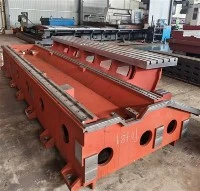

In the machine tool manufacturing system, castings serve as the main load-bearing components and precision benchmarks. Their design philosophy not only determines the performance of individual parts but also profoundly impacts the rigidity, vibration resistance, and long-term stability of the entire machine. Modern machine tool casting design has transcended simple structural forming, shifting towards a systemic approach based on mechanical analysis and guided by functional integration, striving for an optimal balance between weight, stiffness, vibration reduction, and cost.
The primary philosophy is the synergistic optimization of rigidity and lightweighting. Basic components such as the bed, column, and crossbeam must minimize inertial mass while bearing cutting forces, gravity, and thermal loads to improve dynamic response speed. Utilizing finite element analysis (FEA) and topology optimization techniques, redundant materials can be identified and removed while meeting strength and stiffness constraints, resulting in a biomimetic structure with rationally distributed stiffeners and gradually varying wall thickness. This design avoids deformation caused by localized weaknesses and reduces the overall machine load, creating conditions for high-speed, high-precision machining.
Secondly, it involves the proactive shaping of vibration reduction and damping performance. Cast iron, due to the natural damping properties of its graphite structure, possesses unique advantages in suppressing vibration transmission. In design, controlling the graphite morphology and matrix structure, combined with optimized cross-sectional shape, guides vibration energy to attenuate efficiently within the casting. A well-designed rib layout and cavity structure can block resonance paths, reduce chatter risks during cutting, and ensure surface finish and tool life.
Thirdly, precision and stability are paramount considerations. Residual stresses are generated during solidification and cooling. If the stress distribution pattern is ignored in the design, slow deformation can easily occur during subsequent machining or use. Modern design emphasizes symmetrical structures, uniform wall thickness, and progressive transitions, supplemented by simulated and predicted shrinkage and stress concentration areas, thereby reducing deformation tendency at the source. Simultaneously, pre-setting machining allowances and datum surface positions makes it easier to achieve micron-level precision in subsequent finishing.
Furthermore, modularity and manufacturability are also incorporated into the design principles. Standardized interfaces and serialized cross-sections can shorten the casting mold preparation cycle and improve production flexibility; a reasonable parting surface and draft angle design can reduce casting defects and increase yield.
In summary, the design philosophy of machine tool castings has shifted from experience-driven to data and simulation-driven, integrating structural mechanics, materials science, and manufacturing processes. With the core principles of combining rigidity and flexibility, damping optimization, and precision pre-control, it provides a solid foundation for the stability and precision of high-end machine tools.