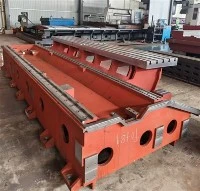

In the field of heavy equipment manufacturing, the machining of large, complex, and precision-critical parts has always been a major challenge. Floor-type boring and milling machines, with their unique structural design and functional integration, have become key equipment for overcoming this bottleneck. Their practicality has been widely proven in the energy, shipbuilding, and rail transportation sectors.
The core practical value of floor-type boring and milling machines is primarily reflected in their ability to machine ultra-large workpieces. Their floor-standing layout and fixed or movable wide worktable can directly support heavy components ranging from several meters to over ten meters in length, avoiding the cumulative errors caused by segmented machining. For example, components that are difficult to disassemble, such as nuclear power plant rotors and marine diesel engine blocks, can be machined as a whole in a single setup, significantly improving dimensional accuracy and machining efficiency. The high-rigidity bed and column structure effectively suppress heavy cutting vibrations, ensuring dimensional stability during long-term operation, and are particularly suitable for high-intensity, continuous production demands.
In terms of precision assurance, floor-type boring and milling machines rely on precision guideways, high-resolution detection systems, and advanced CNC technology to achieve micron-level positioning and repeatability accuracy. Whether it's controlling the straightness of deep hole boring or milling complex curved surfaces, they can strictly meet the geometric tolerance requirements of high-end equipment, providing reliable support for the quality of key components.
Functional integration further expands their practical boundaries. Modern models integrate boring, milling, drilling, and tapping processes into one unit. With a CNC rotary table or angle milling head, multi-faceted and multi-angle machining can be completed in a single setup, reducing process turnover and datum conversion errors, and significantly improving production flexibility and consistency. This "one-stop" machining mode not only reduces reliance on multiple machines but also shortens the manufacturing cycle, aligning with the trend of efficient and intensive production.
Faced with the upgrading demands of large-scale and precision manufacturing, floor-type boring and milling machines, with their comprehensive advantages in spatial adaptability, precision reliability, and process integration, continue to provide solid support for the major equipment manufacturing industry, becoming an important cornerstone for promoting industrial upgrading.