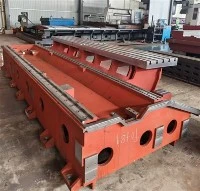

As a fundamental reference tool for precision manufacturing and testing, the installation quality of a cast iron platform directly affects the flatness maintenance of the working surface and its long-term service accuracy.The installation process is not simply about placing it in place; it requires a series of rigorous steps, including environmental preparation, foundation treatment, leveling, and securing it, to ensure it can function as a stable and reliable reference under various working conditions.
Environmental survey and foundation preparation before installation are paramount. The cast iron platform should be placed in a dry, well-ventilated location with minimal temperature changes, avoiding direct sunlight and proximity to heat sources to minimize the adverse effects of thermal expansion and contraction on flatness. If the foundation is a concrete structure, it must meet the design strength and age requirements, and the surface should be flat without obvious cracks or unevenness. If it is a steel frame or ground rail support, its rigidity and levelness should be checked to ensure it can withstand the platform's own weight and workpiece load without significant deformation.
Before placing the platform, dust, oil, and debris should be removed from the foundation surface and the bottom of the platform, and the working surface should be inspected for any transportation damage or rust. For large platforms, specialized lifting equipment or forklifts should be used for smooth handling to avoid collisions, impacts, and lateral forces. Lifting hole positions should strictly adhere to the design specifications, and corner guards should be added to prevent damage.

Leveling is the core step in determining installation accuracy. A precision level, electronic level, or laser interferometer can be used to measure multiple points in the longitudinal and transverse directions of the working surface. By adjusting shims or anchor bolts, the platform should achieve the designed levelness and flatness. Adjustment must be performed in stages: first coarse adjustment, then fine adjustment. A certain amount of counterweight should be added at different locations to simulate actual working conditions, and the changes in readings should be observed to ensure that the adjustment results remain acceptable under full load. After fine adjustment, the fixing bolts should be tightened evenly in the prescribed sequence to prevent localized stress concentration that could lead to platform deformation.
Fixing and protection are equally important. After tightening the bolts, the flatness should be re-measured to ensure there is no deviation before use. For platforms requiring long-term fixation, anti-slip pads or locating pins can be installed at the bottom to improve their resistance to overturning and displacement; for portable platforms that may be moved, locking devices should be provided. Protective railings or signs should be installed around the work area to prevent impacts from heavy objects and to avoid unauthorized personnel stepping on it.
After installation, an initial accuracy file should be established, recording the installation date, environmental conditions, level data, and test results to provide a basis for subsequent periodic verification and maintenance. Before first use, a no-load test run should ideally be conducted to observe for any abnormal vibrations or noises, verifying the stability of the installation.
In summary, the installation of a cast iron platform is a systematic task integrating a stable foundation, precise leveling, reliable fixing, and comprehensive protection. Only by strictly adhering to procedures and standards can a solid and lasting benchmark be provided for subsequent precision machining and measurement.